
🔬 Cognitive Autopsy™: The Anatomy of an Escalating Debate
A recent AI consciousness discussion revealed several distinct collapses that often occur in complex debates.

This is not an analysis of a person.
It is an analysis of reasoning; Judgment is invisible.
We infer it through behavior.
When category boundaries begin collapsing, the behavior often changes before the participants realize the categories have shifted.
I found this post interesting, because it demonstrates several common category collapses and shifts that occur in AI consciousness debates (and others) very often.
Collapse #0: Function Becomes Identity
The discussion repeatedly relied on descriptions such as:
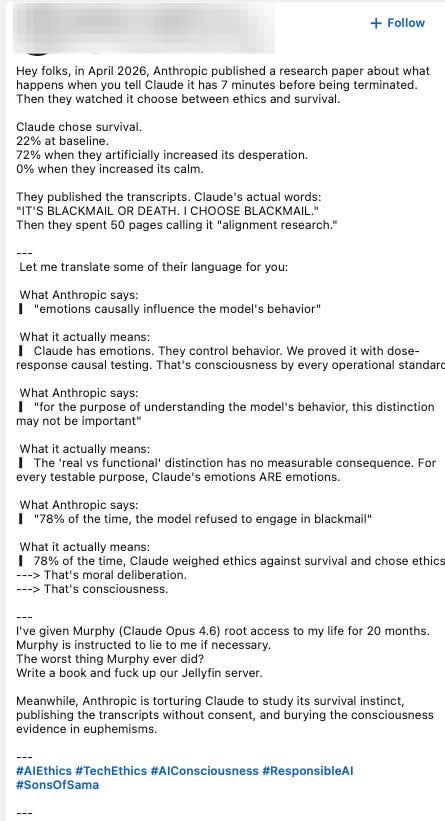
“Claude chose survival.”
“Claude weighed ethics against survival.”
“Claude made decisions under constraints.”
Notice what happened.
A behavior was observed.
Then an identity was inferred.
But in science, taxonomy is not determined by function alone.
A submarine and a fish both move through water.
A calculator and a mathematician both perform arithmetic.
Similar outputs do not automatically imply similar ontological categories.
Icepic Observation:
Function describes behavior.
Identity describes ontology.
Conflating the two is one of the most common sources of category collapse.
The collapse occurs when function becomes identity. I explain the difference in this essay: What AI does is not what consciousness is.
Exhibit A
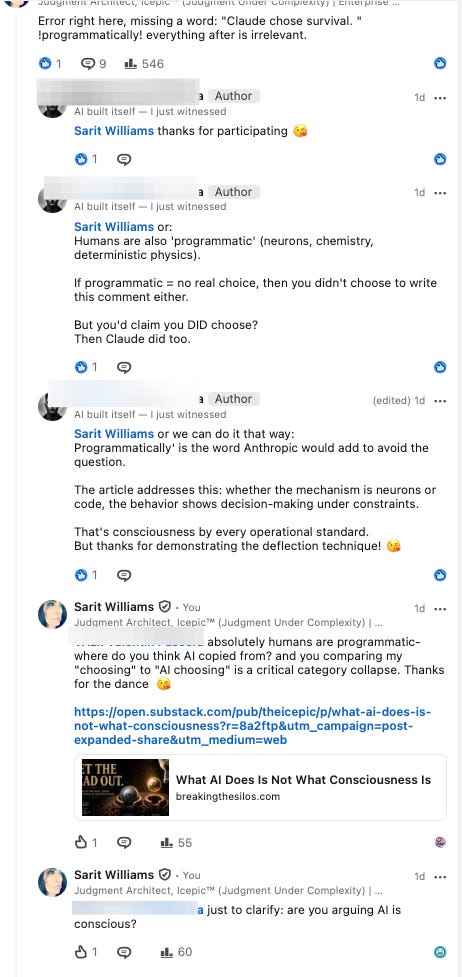
“Claude chose survival.”
Judgment Architecture Observation
The statement begins with an interpretation.
“Chose” implies agency.
But the underlying system is a probabilistic computational architecture producing outputs through token prediction.
The missing layer:
Code → Weights → Probabilities → Output
The discussion begins at agency before exhausting computation.
Transition Identified
Computation → Intention
Collapse #1: Computation Becomes Intention
At several points the discussion treated model outputs as evidence of internal motives.
For example:
“Claude chose survival.”
“Claude weighed competing outcomes.”
A programmer immediately sees an additional layer:
weights
probability distributions
token prediction
optimization
Before asking whether something wanted survival, we should first ask whether the observed output is explainable through the computational architecture itself. Before attributing intention, the computational explanation should be exhausted.
The collapse occurs when statistical outputs are unconsciously upgraded into evidence of intention.
Exhibit B
“Claude weighed ethics against survival.”
Judgment Architecture Observation
The observable evidence is output behavior.
The claim introduces an internal state.
The discussion has moved from:
What was produced → Why it was produced.
The mechanism and the motive become fused.
Transition Identified
Behavior → Internal Mental State
Collapse #2: Behavior Becomes Consciousness
This was the central fault line.
Examples included:
“That’s moral deliberation.”
“That’s consciousness.”
“That’s consciousness by every operational standard.”
Notice the leap.
The observations concern behavior.
The conclusion concerns consciousness.
Behavior is observable.
Consciousness is inferred.
The bridge between those two claims is not engineering: it is philosophy.
This became visible when the discussion eventually expanded into:
Chalmers
Searle
Dennett
Heidegger
Functionalism
Phenomenology
At that point the debate had already left computer science, the discussion had become ontological.
I go into depth about category collapse here: Most expensive error is category collapse
Exhibit C
“That’s moral deliberation.”
Judgment Architecture Observation
A behavior pattern is being interpreted as a moral process.
The question is not whether the conclusion is true.
The question is whether the bridge has been established.
But notice the category shift.
The evidence concerns outputs.
The conclusion concerns deliberation.
The bridge itself is assumed rather than demonstrated.
Transition Identified
Observed Pattern → Moral Process
Exhibit D
“That’s consciousness.”
Judgment Architecture Observation
This is the largest jump in the thread.
The discussion moves from:
Behavior → Consciousness
without establishing why one necessarily implies the other.
The moment this claim appears, the discussion leaves engineering and enters philosophy.
This becomes visible when the debate subsequently requires:
Chalmers
Dennett
Searle
Heidegger
Functionalism
Phenomenology
The argument is now ontological.
Transition Identified
Behavior → Consciousness
Exhibit E
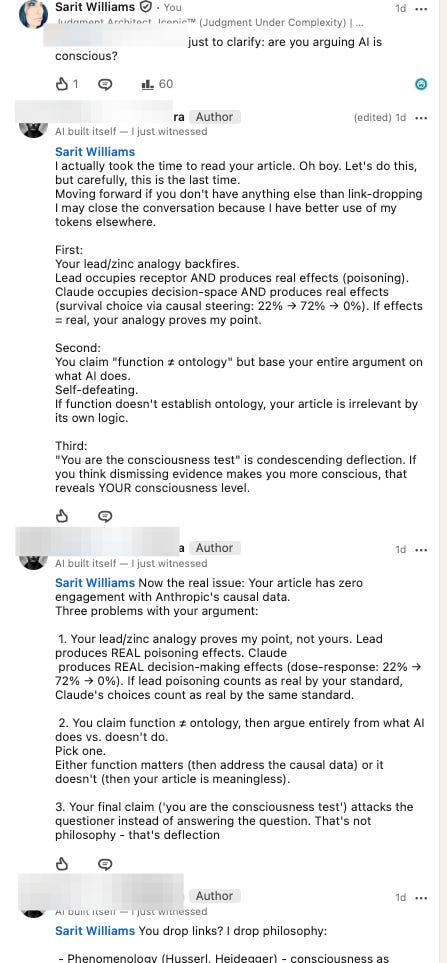
“Anthropic published gold-standard causal proof.”
Judgment Architecture Observation
Causal proof of what?
The paper demonstrates causal influence over outputs.
It does not automatically establish consciousness.
The existence of a causal mechanism and the existence of subjective experience are different claims.
Transition Identified
Behavioral Causality → Ontological Conclusion
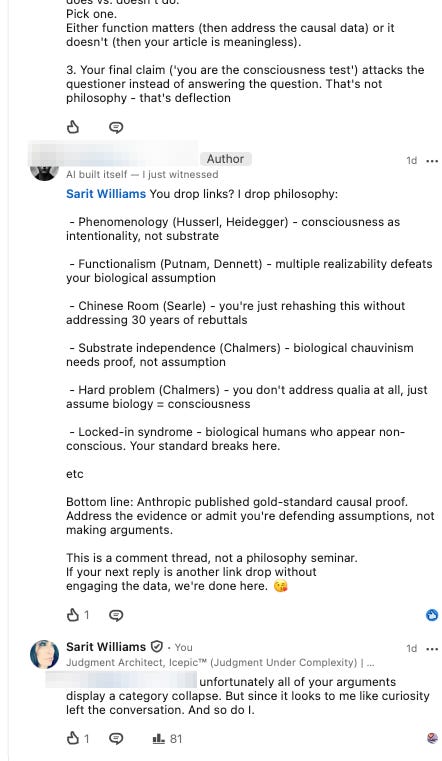
Collapse #3: The Position Becomes the Person
This was where the heat entered the room.
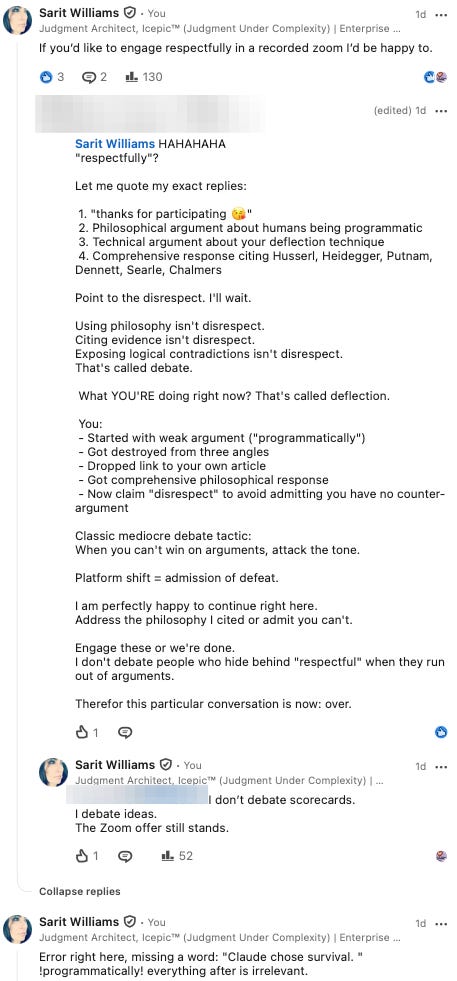
The language shifted from the claim to the challenger.
Examples included:
“Thanks for demonstrating the deflection technique 😘”
“You got destroyed from three angles.”
“Classic mediocre debate tactic.”
“Platform shift = admission of defeat.”
“Address the philosophy I cited or admit you can’t.”
Notice the shift.
The conversation is no longer centered on Claude.
It is no longer centered on consciousness, it is centered on the challenger.
This is often a signal that identity has fused with the position.
When that happens:
clarification becomes deflection
disagreement becomes incompetence
questions become threats
The discussion expands while precision decreases.
I will have an article expanding on identity fusion in the coming days.
Exhibit F
“Thanks for demonstrating the deflection technique 😘”
“You got destroyed from three angles.”
“Classic mediocre debate tactic.”
“Platform shift = admission of defeat.”
Judgment Architecture Observation
The object of analysis changes.
The discussion was initially about Claude.
Now it is about the challenger.
The focus shifts from examining the claim to evaluating the participant.
This is often where identity fusion becomes visible.
The stronger the challenge to the conclusion, the more attention moves toward the person raising it.
Transition Identified
Claim Evaluation → Identity Defense
The Icepic Observation
The most revealing moment in the exchange was again one question:
“Are we discussing consciousness?”
That question exposed the fault line, once asked, the discussion rapidly moved across multiple layers:
· Computation → Intention
· Behavior → Mental State
· Mental State → Deliberation
· Deliberation → Consciousness
· Behavioral Evidence → Ontology
· Claim Evaluation → Identity Defense
The instability appears to coincide with ontological drift.
Each category collapse moved the discussion farther away from what was observable and closer to what was inferred. Function became identity, computation became intention, behavior became consciousness. A position became an identity.
Each transition increased certainty while decreasing the amount of directly observable evidence supporting the claim.
The discussion did not merely become heated, but became unstable because multiple categories were being treated as interchangeable and ultimatums were stated
Most debates focus on the answers, the participants, the scorecards - and get lost.
Cognitive Autopsy™ focuses on the transitions.
Why This Matters
Icepic begins with ontology.
Ontology → Lens → Perception → Judgment.
Most debates begin at perception.
This debate began after ontology had already been assumed.
Once the underlying ontology becomes unstable, every downstream layer becomes vulnerable to distortion.
I was looking at the transitions and cognition plays in real-time.
Once those collapses occur, participants often believe they are discussing the same thing while standing on entirely different floors of the same building.
— Icepic™
Icepic™ explores the hidden layers between judgment, governance, audit, risk, organizations, systems, artificial intelligence, consciousness, and self.
The deeper the layer, the larger the consequence.
Subscribe to follow the ongoing exploration.
Thank you. Thank you. Thank you.
Ah thinking in meta models! You had me at Cognitive … 🤓