
Governance Poisoning
When Certified Expertise Accelerates the Wrong Answer

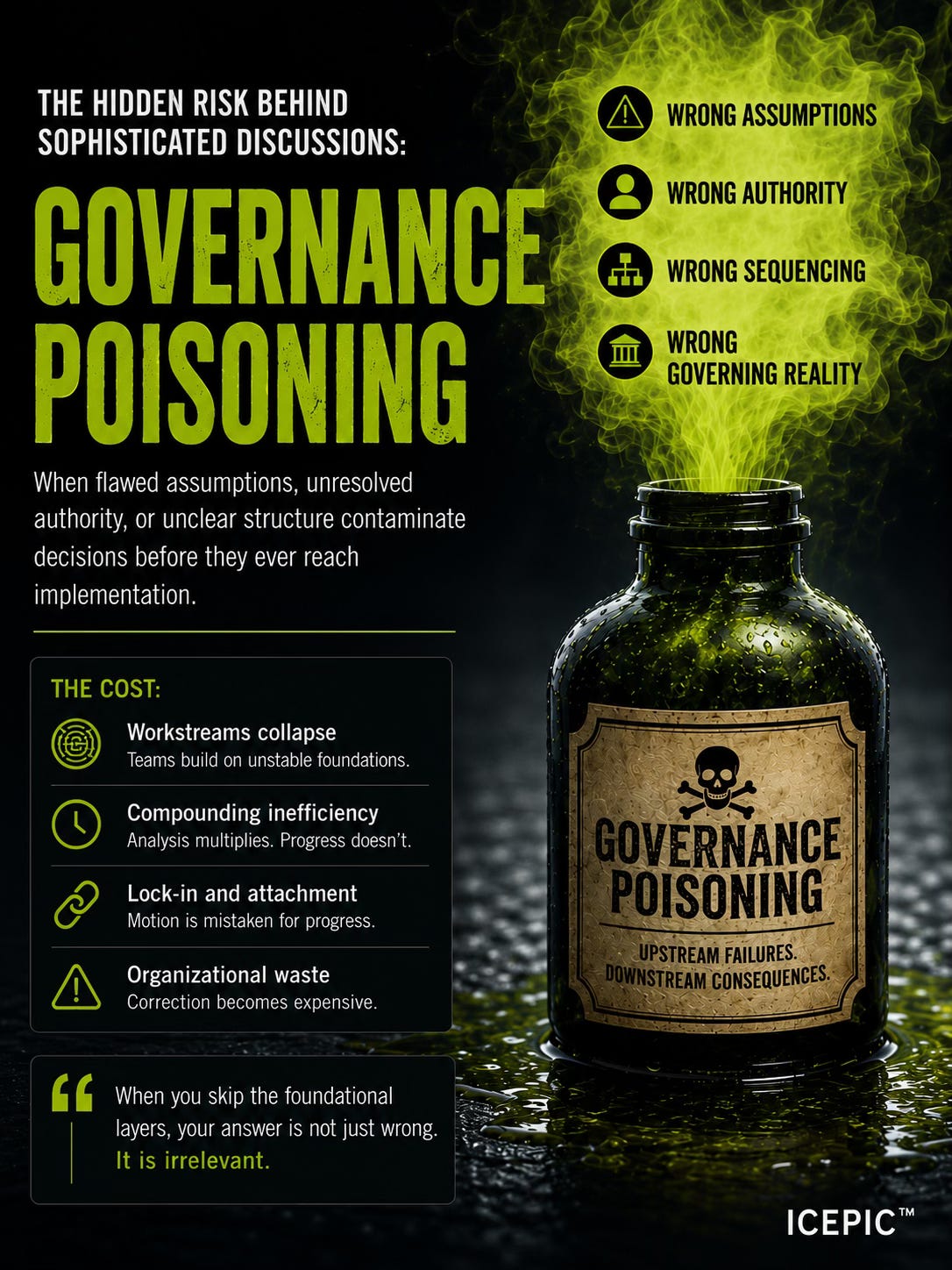
A recent respectful forum discussion centered around a seemingly technical CMMC question involving a joint venture.
The original post asked:
“If Partner A is certified CMMC L2, but Partner B is not, can Partner A’s SSP cover Partner B if B uses A’s system?”
My first reaction is that the question exposes a governance boundary problem more than a technical CMMC problem. The issue is not “can Partner A’s SSP cover Partner B?”
The real issue was who owned the risk, operational authority, identity boundary, and attestation legitimacy inside the joint venture structure.
Because mergers, acquisitions, and joint ventures create ontological ambiguity. The org chart changes faster than the governance model. Operational integration accelerates while authority boundaries remain unresolved.
That distinction matters.
So people start asking infrastructure questions to solve what is actually an authority question: legal, technical, contractual, operational, or managerial.
“Can A’s SSP cover B?” was really shorthand for whether governance authority could be inherited across partially integrated organizations.
And the uncomfortable answer is: only to the extent that operational control is truly centralized and demonstrable.
Otherwise you create a certification illusion where the paperwork says “covered,” but the actual governance model is fragmented.
That becomes a risk because CMMC is increasingly evidence-based and operationally validated. Assessors are going to look for consistency between:
declared scope,
actual administrative control,
HR governance,
technical enforcement,
and contractual responsibility.
A JV that shares systems without unified governance is exactly the kind of structure that creates hidden accountability gaps.
The Industry Keeps Mistaking Interpretation for Judgment
Most of the responses immediately accelerated into downstream implementation logic:
“If the systems stay inside the enclave…”
“If the SSP documents it…”
“If the UID is included…”
“If the controls are inherited…”
But none of those answer the governing question:
What legally exists?
The legal structure determines what the entity actually is, who can bind whom, who carries liability, who possesses operational authority, who can attest, and whether the proposed system boundary is even legitimate in the first place.
A joint venture is not primarily a technical structure, it is the pending legal answer that would affect technical structure design.
Only after those realities are established does technical implementation become meaningful.
Yet the industry increasingly reverses this sequence completely.
The Most Important Clue That Everyone Skipped
The original poster explicitly stated:
“The speaker made the statement that DoD has given no guidance on how to deal with Joint Ventures.”
That should have immediately changed the posture of the discussion.
It didn’t.
Even when a participant later included DoD FAQ language, the answer itself reverted back to conditional structure-dependent logic:
“The identified CMMC UIDs may apply to individual JV members or to the JV itself…”
“…if the JV operates using systems and networks that serve multiple members.”
In other words, the guidance itself presupposed organizational and operational structure before technical interpretation could occur.
The discussion quickly filled with detailed responses:
enclave scoping,
SSP inheritance,
system boundaries,
UID interpretation,
access controls,
shared environments,
and assessment implications.
And all of them missed the governing issue entirely: the question was never primarily technical.
It was ontological.
The DoD did not say:
“Partner A can cover Partner B.”
The DoD effectively said:
“Depending on what legally and operationally exists, different scoping realities may apply.”
That is a fundamentally different statement.
But many readers unconsciously flattened:
conditional guidance
into
generalized implementation permission.
This is where governance failures begin.
Architecture Cannot Define Legitimacy
Cybersecurity professionals increasingly attempt to solve governance ambiguity through technical interpretation.
They ask:
Can the SSP inherit?
Can the enclave extend?
Can the boundary absorb another entity?
Can controls be shared?
But architecture cannot create legitimacy, it can only operationalize legitimacy that already exists. This is why so much cybersecurity analysis feels sophisticated while remaining structurally unsound.
The reasoning begins downstream of unresolved authority, and once the upstream variable changes, the entire technical analysis collapses with it.
Certification Does Not Equal Judgment
This is where the issue becomes uncomfortable.
The participants in the discussion carried impressive authority markers:
governance certifications,
CMMC ecosystem credentials,
risk management designations,
executive advisory titles.
But certifications primarily validate framework familiarity, terminology recognition, process exposure, and conceptual knowledge…not understanding.
Certifications do not explicitly validate practical application, sequencing discipline, reasoning, governance maturity, or judgment.
That distinction has enormous operational consequences.
AI is now capable of generating highly polished downstream interpretation from fundamentally unvalidated premises. Which means:
fluency and knowledge is becoming cheap.
Judgment and understanding is not.
The Real Failure Was Sequencing
It is obvious the individuals did not lack cybersecurity knowledge, the problem was that they answered the wrong layer of the question.
The disciplined response was not: Here is how SSP inheritance might work.
It was:
“This depends on the legal structure of the entities and the JV before technical implementation can be evaluated.”
That answer sounds less sophisticated, but it demonstrates far greater judgment.
Mature governance reasoning recognizes authority before architecture, structure before interpretation, and legitimacy before implementation.
Ultimetly, organizational failure is often the downstream consequence of upstream sequencing errors: flawed assumptions, misplaced authority, and unresolved governing structure.
Premature Interpretation Creates Organizational Lock-In
Is there any danger in just entertaining discussions? no.
The risk is organizations analyzing assumptions before upstream authority has stabilized. And once organizations become emotionally invested in a direction, motion itself begins masquerading as progress.
Sophisticated discussion creates perceived legitimacy long before legitimacy has actually been established.
Workstreams Collapse: everyone keeps building analytical branches downstream of a variable that has not yet been authoritatively fixed. Answering ontological questions first can absolutely alter technological design.
Compounding inefficiency: meetings multiply, architects start designing, consultants start advising, security teams start modeling, compliance teams start documenting, and leadership starts anchoring psychologically on speculative interpretations.
Emotional and psychological attachment: people frequently confuse motion with progress. More sophisticated discussions, whiteboards, framework mapping,
implementation theories, and collaborative nuance makes it difficult for people to revert- they’ve become emotionally invested in ideas.
Proper sequencing in governance is not philosophical rigidity-it is operational discipline.
Small upstream sequencing failures compound into downstream architectural, organizational, and strategic waste.
Because organizations do not merely discuss assumptions, they operationalize them, and once speculative interpretations gain momentum, correction becomes expensive.
When you skip the foundational layers, your answer is not just wrong. It is irrelevant.
If this perspective resonates
Future pieces will continue exploring:
AI
governance
interpretation
organizational judgment
and the hidden layers between systems and perception.