
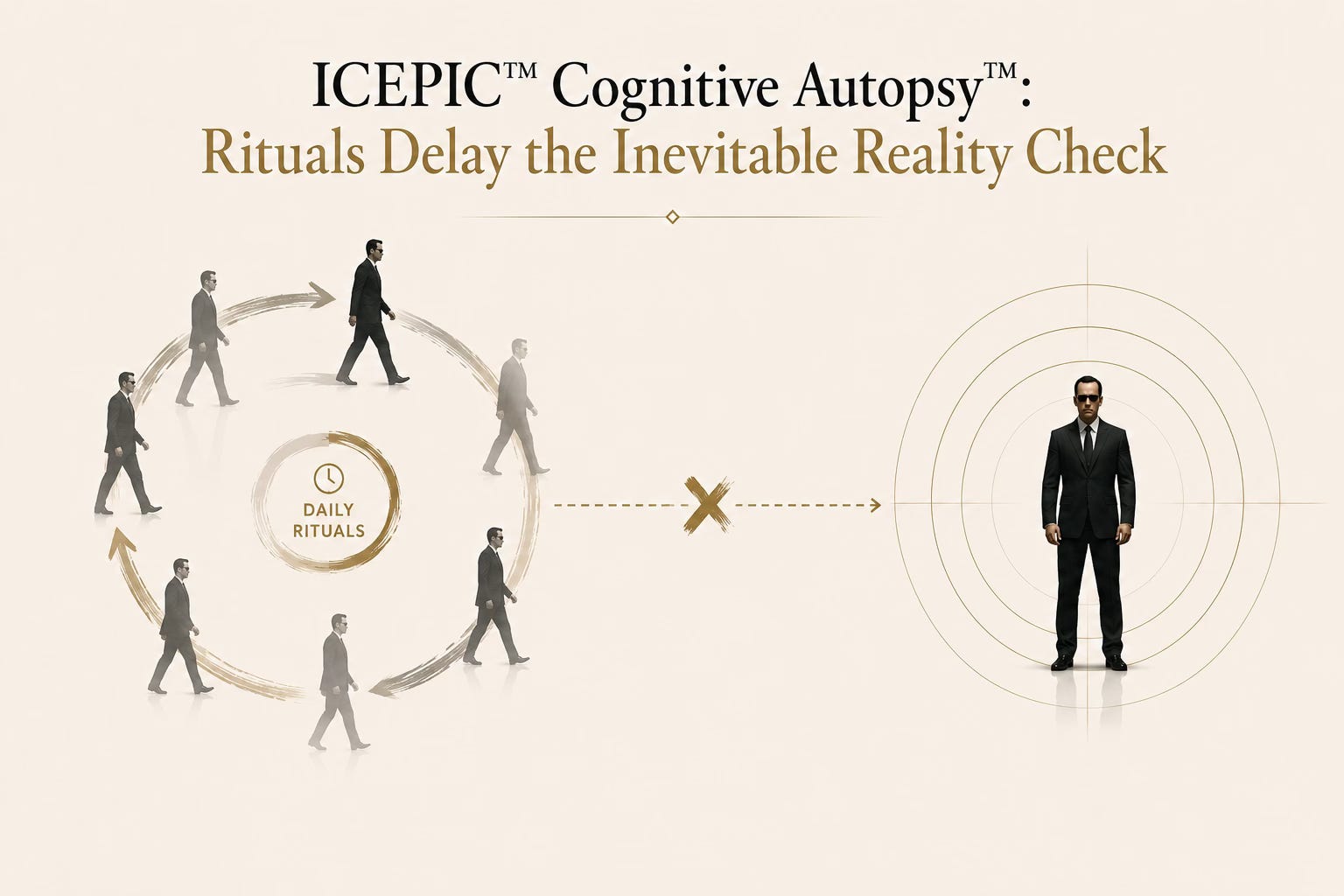
ICEPIC™ Cognitive Autopsy™: Rituals Delay the Inevitable Reality Check
Why transitions reveal structural architecture rather than resolve it.

Patient
“You Can’t Out-Schedule a Lack of Transitions”
By Matt Tillmann
Article Summary
In “You Can’t Out-Schedule a Lack of Transitions,” Matt Tillmann argues that many people struggle not because they lack time management, but because they lack intentional transitions between the different roles they occupy throughout the day.
Using a personal story of arriving home physically present but mentally still at work, he describes the experience of carrying emotional and cognitive residue from one environment into another. He draws on concepts including attention residue (Sophie Leroy), work-home boundary theory (Blake Ashforth and Glen Kreiner), and habit loops (Jud Brewer) to argue that unresolved mental carryover leaves people exhausted, disconnected, and unable to fully engage with their families.
Tillmann proposes that the disappearance of the daily commute - particularly with remote work - removed an important psychological buffer between professional and personal life. To replace that missing buffer, he introduces the metaphor of an “airlock,” describing it as a deliberate pause between environments that allows one identity to end before another begins. He suggests three simple transition rituals: listening to a song, taking a walk, or speaking a closing sentence aloud.
His deeper assumption is that modern life requires movement between “different yous”: Work You, Parent You, Partner You. The article treats transitions as the mechanism that helps one version end so another can begin.
For ICEPIC™, that assumption becomes the starting point for the investigation. There are not different selves; there is one self operating under different constraints. The problem is not identity-switching. It is maintaining coherent judgment as constraints change.
That is where the Cognitive Autopsy™ begins.
Read on to understand - and apply - the exact reality correction to this very real challenge.
Symptoms
The patient presents with the following observations:
Mental carryover from work into home.
Emotional residue after difficult meetings.
Reduced presence with family.
Fatigue despite sufficient scheduling.
Multiple competing identities (“Work You,” “Parent You,” “Partner You.”)
These observations are genuine.
The question is whether the diagnosis matches the symptoms.
The First Judgment
The article begins with an observation. “I wasn’t really there.”
This is an observation.
Not yet a conclusion.
Then comes the first judgment —>The problem is a lack of transitions.
Notice what happened.
An observation became a diagnosis.
That movement happens so naturally most readers never notice it.
ICEPIC does.
Second Judgment Move: Explanatory Stacking
He imports external frameworks. Attention residue (Sophie Leroy), work-home boundary theory (Blake Ashforth and Glen Kreiner), and habit loops (Jud Brewer).
Attention residue
Boundary theory
Habit loops
Nervous system regulation
Each explains part of the observation.
Together they create the appearance of a complete explanation.
But they’re only additive to an assumption that morphed into diagnosis.
Third Judgement Move
He introduces the metaphor: Airlock.
The metaphor works emotionally. He also proposes interventions, that do work for some because rituals often create state interrupt by utilizing distractions. Until reality comes to collect via new rituals or collapse.
But metaphors can hide architecture.
An airlock equalizes pressure—>remember pressure release is reality relocates consequences- temporarily, not solve the cause.
An airlock equalizes pressure between two environments. If the hull itself is cracked, does the airlock repair it?
The question is: What makes objective reality register as pressure in the first place?
The article never defines it.
Where ICEPIC Separates
The article repeatedly describes: “I wasn’t present.” and answers that question with the provided rituals “to become present” which will work for some, at least temporarily.
ICEPIC wants to know: What remains unresolved? right now? the song, the walk, the talking aloud are all distractions from silence. the ability to feel and think what remains. what is keeping me “not present”?
If the meeting was not especially perturbing your mind and emotion there would be no need for the airlock to help transition. However,
Suppose the meeting involved:
moral conflict
uncertainty
fear
unresolved decision
deception
accountability
No song, walk, or sentence resolves that. Certainly it will appear that way, but the foundation still cracked and demands attention.
The unresolved judgment remains.
The Largest Compression
Throughout the article, several distinct concepts gradually become treated as though they are interchangeable:
attention
stress
nervous system
role (Icepic described this in Organizations Don’t Ask You to Lie. They Manufacture Blindness.)
identity
presence
transition
These concepts are related, but they are not equivalent. Yet each compression moves the explanation one step further away from the originating architecture.
The movement between them is subtle enough that most readers never notice it.
ICEPIC™ calls this phenomenon Ontological Compression™: the gradual loss of distinction between different layers of reality until they appear to be a single explanatory category.
By the end of the article, the transition itself has become the explanation.
Near the end, Tillmann states: “…keeps one identity’s exhaust from polluting the next one.”
But “identity” becomes treated like contamination and it assumes that’s actually possible- it’s not. mistaking the transitions for different identities produce different interventions that will be tested against reality to see if they hold.
Pressure Test
Think about a bridge:
Bridge A supports 100 cars.
One day a bicycle crosses.
No problem.
The next day a fully loaded semi crosses.
The bridge cracks.
Did the bridge architecture change?
No.
The bridge failed because reality changed.
Reality simply revealed what the bridge could—and could not—support. Human judgment behaves the same way.
Think about two employees leaving the same meeting.
Both heard the same discussion.
Both observed the same behaviors.
Both walked out at the same time.
Both listened to the same transition song.
Both took the same walk.
Both spoke the same closing sentence.
Yet only one of them arrived home feeling present. Why?
Employee A interpreted the meeting as routine. Their existing judgment architecture found coherence with what occurred, allowing the ritual to reinforce an already stable state.
Employee B registered something fundamentally different. Perhaps they observed deception. Perhaps they experienced moral conflict. Perhaps something challenged a deeply held assumption. The same external reality produced a different internal judgment because the architecture through which it was encountered was different.
The ritual could regulate emotional state.
It could not resolve what judgment had left unresolved.
The article attributes improvement primarily to the transition.
ICEPIC asks a different question:
What architecture produced two different judgments of the same reality?
Reality is truth, reality always tests architecture - architecture is where fault appears- always.
Reality tests judgment architecture.
Judgment architecture determines what, in objective reality is registered as load, where that load propagates, and where it ultimately fractures.
What the Article Gets Right and Then Stops
It correctly identifies:
boundaries matter
role contamination exists
rituals influence cognition
calendars cannot regulate mental state
transitions deserve intentionality
Those are all reasonable observations. ICEPIC continues beneath behavior because a ritual may reduce the feeling of carryover without resolving its source.
The article repeatedly describes environments characterized by performance, unspoken meaning, agreeableness, and office politics. Those observations may be important because they describe conditions in which judgment itself becomes increasingly expensive. They also suggest the investigation may need to begin earlier than the transition itself.
Primary Cause of Death
Ontological Compression™ resulting in the substitution of an artifact for its generating architecture.
Contributing Factors
Identity treated as architecture rather than expression.
Transition treated as mechanism rather than artifact.
Ritual treated as resolution rather than regulation.
Multiple explanatory frameworks stacked until they appeared to constitute a single causal explanation.
It misidentifies the level at which that phenomenon originates. The article correctly observes the phenomenon but attributes it primarily to the absence of a transition ritual rather than first establishing what mechanism is actually crossing the boundary.
That doesn’t make the advice ineffective. The suggested rituals may genuinely help many people. From an ICEPIC perspective, they function more like regulation tools than explanations of the underlying architecture.
The person should rather spend time in silence identifying what is not dealt with that requires attention to resolve. The architecture is asking to be corrected or reinforced with external behavior.
Organizational Architecture
The same architectural phenomenon appears in organizations. The judgment architecture of an organization eventually manifests as resilience or fragility, high trust or political behavior, low attrition or constant turnover, depending on what objective reality repeatedly reveals. The organization attempts to airlock moral with team lunch, a new policy, a revised governance framework, culture initiative, or a complete reorg.
These often function as organizational airlocks, creating the appearance of transition while leaving the underlying judgment architecture untouched. The organization feels different for a time, yet the same conflicts, blind spots, political behaviors, and governance failures inevitably return. The ritual changed. The architecture did not.
From an ICEPIC™ perspective, organizations do not fail due to lack of transitions any more than individuals do. They fail because unresolved judgment remains embedded in the architecture that forms decisions, incentives, authority, and accountability.
Until that architecture changes, every new initiative merely delays the next reality check. Reality does not test mission statements, policies, or rituals. It tests the judgment architecture from which they emerged and whether those mission statements, policies or rituals hold as true.
Icepic™ explores the hidden layers between judgment, governance, audit, risk, organizations, systems, artificial intelligence, consciousness, and self.
The deeper the layer, the larger the consequence.
Subscribe to follow the ongoing exploration.
Wonderful breakdown and read. I find the way you hold things up for inspection very important.
Words matter.
This is really profound. Finally someone gets to the core of what we call issues and problems.