
Organizations Don’t Ask You to Lie. They Manufacture Blindness.
How institutional roles quietly govern perception before judgment even begins.

Organizations ask you to bring your experience, education, credentials, skills and diversity into the role. In exchange, you receive a salary, benefits, PTO, career progression, and a culture designed to make the arrangement feel mutual. However, there is another exchange happening underneath the visible one. The organization does not include anything more beyond what’s stated, but YOU - you include something extra, and most people never realize they agreed to it.
Because the organization does not merely purchase your labor, over time, it begins shaping your perception. Thinking is technically included in the role, but eventually, the role begins thinking through you.
Because every role carries an embedded ontology — a definition of what matters in this environment, what risks matter, what success means, what behaviors are rewarded, and what is allowed to count as acceptable, reasonable, professional, or even visible.
Over time, people adapt to the lens of the role.
Eventually, they stop noticing the lens exists at all.
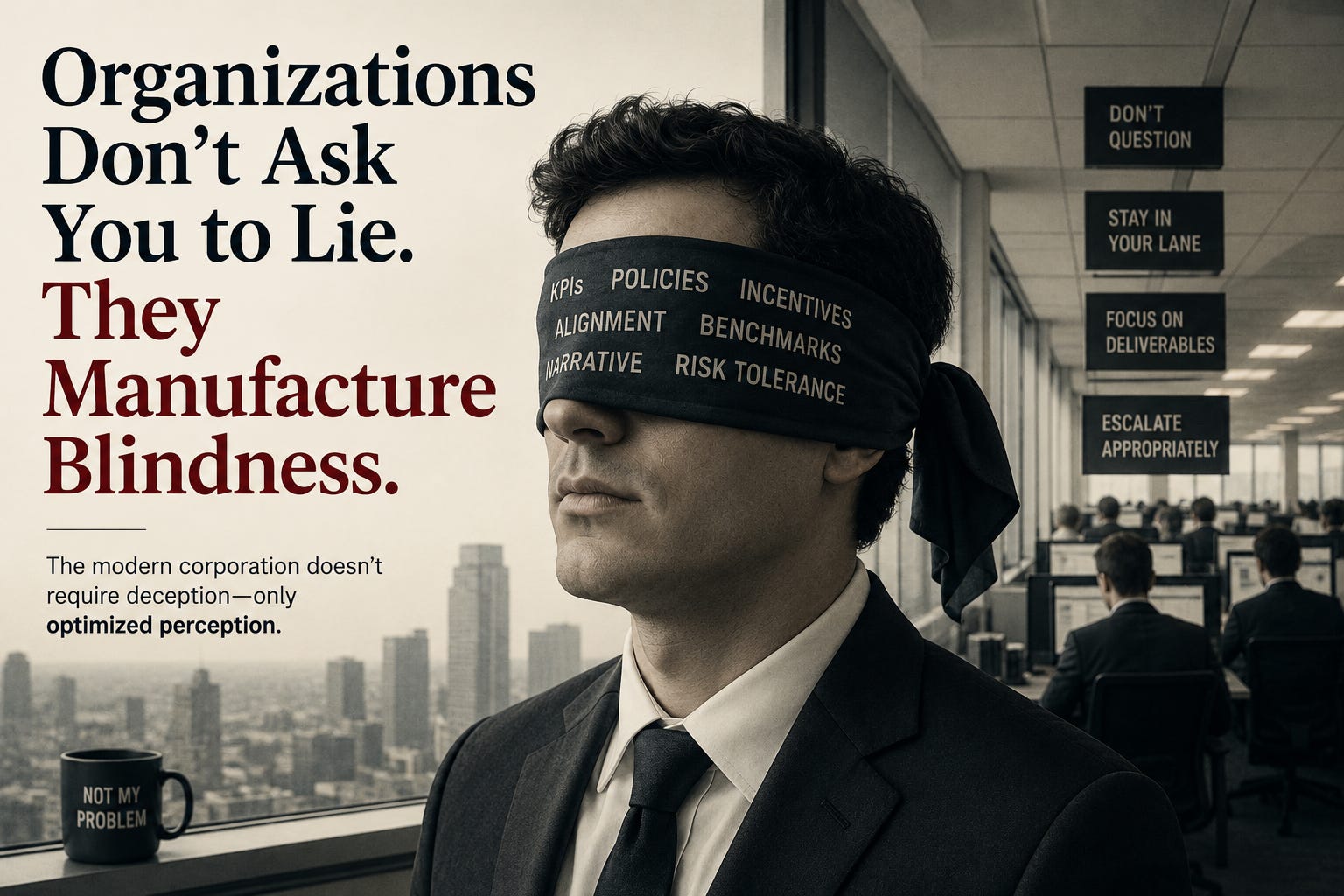
This is not merely organizational behavior, it is structural cognition operating beneath complex systems.
AI simply makes the mechanism visible: intelligence constrained by ontology, incentives, and permitted perception. Humans are not exempt from the same architecture.
An AI model constrained by training data, reward functions, optimization targets, and system boundaries can only perceive within the ontology it was designed to prioritize. It may appear intelligent, but its intelligence remains bounded by the architecture defining relevance, coherence, acceptable output, and friction reduction.
Humans inside organizations are not much different.
The HR executive does not simply “evaluate people.” They are structurally conditioned to prioritize:
policy exposure reduction
legal defensibility
process consistency
organizational liability containment
behavioral conformity
hierarchical alignment
That is the moment judgment becomes subordinate to role script.
Not through coercion.
Through adaptation.
So when an employee presents something existential, systemic, or strategically inconvenient, HR often cannot fully perceive it because the role itself compresses reality into administratively legible categories.
HR may be empathetic, they may be there to help the employee feel safe, heard, and supported, but once truth collides with hierarchy preservation, the role stops optimizing for accuracy and starts optimizing for institutional survivability.
The finance leader begins seeing the world through allocation efficiency and controllable spend.
The cybersecurity leader begins perceiving attack surfaces everywhere.
The legal department increasingly interprets ambiguity as exposure.
Operations sees throughput.
Marketing sees narrative.
Executives see political survivability.
Every function narrows perception around what the role rewards, and the longer someone remains inside a role, the more the ontology hardens into identity. This is where organizations become destructive while simultaneously claiming to solve the very outcomes they help produce.
Because eventually people stop asking:
“What is true in this situation?” “
and
“what does my role empower me to act on with sound judgment?”
And start asking:
“What is my function permitted to recognize, escalate, or act upon?”
Those are not the same question.
I once heard a compliance officer describe themselves as “just a paper pusher.”
An HR representative privately acknowledged an employee was right, but admit they could not act against asymmetrical power.
A safety officer unable to implement recovery planning because bureaucratic process had become more important than operational resilience.
A CISO amplifies fear because uncertainty itself became professionally rewarded.
An innovation group detach from operational reality because novelty became more valuable than grounded execution.
A CIO misclassify a procurement platform as “help desk software” because admitting the original procurement failure would implicate executive judgment, governance, and funding legitimacy.
The role is no longer merely influencing judgment.
It is governing perception before judgment even occurs.
Most organizational dysfunction begins right there.
This is why cross-functional meetings so often feel surreal. Everyone believes they are discussing the same problem while operating from entirely different definitions of the situation itself.
The engineer sees system integrity.
The executive sees political timing.
HR sees employee relations risk.
Legal sees discoverability.
Finance sees controllable spend.
Leadership protects status.
Each person appears irrational to the others because each role silently edits reality before discussion even begins.
AI fails this at scale in the same way organizations do:
by rarely questioning the ontology of the actors shaping the system itself.
The model evaluates prompts, constraints, outputs, and optimization targets.
But it often cannot evaluate whether the humans defining those targets are themselves operating from distorted incentives, institutional blindness, political preservation, status protection, or constrained perception.
The system inherits the ontology of its architects.
Just as organizations inherit the ontology of the roles governing them.
AI does not escape human blindness.
It industrializes it.
We understand that models optimize toward reward functions, that outputs are shaped by training environments, and we understand that what is excluded from training changes what can later be perceived.
Humans behave similarly inside institutions, but with one critical difference:
Humans mistake role-conditioned cognition for objective thought.
That is where things become harmful.
Because once identity fuses with role ontology, perception becomes self-sealing.
The HR leader no longer believes they are interpreting reality through HR.
The executive no longer believes they are interpreting reality through political survivability.
The organization no longer recognizes that its own structure is manufacturing blindness.
At scale, this produces institutional hallucination.
The company begins mistaking dashboards for reality, Governance frameworks for control, and cultural language for safety.
Meanwhile the actual environment may already be changing underneath it.
History is full of institutions that collapsed because reality eventually became incompatible with the ontology governing them as no ontology can suppress reality indefinitely.
This is why genuine strategic thinkers are often difficult for organizations to absorb.
They cross ontological boundaries.
They notice contradictions between functions.
They detect signals before categories exist for them.
They violate role-contained perception.
Which means they often appear threatening, confusing, political, or “not collaborative” long before they are understood.
Organizations reward functional optimization.
Reality rewards perceptual adaptability.
Those are not always aligned.
The future belongs less to people with fixed expertise and more to people capable of recognizing when the ontology of their role is no longer sufficient for the environment they are operating within.
Not smarter people.
People who can see the lens itself.
Because the highest form of judgment is not optimizing within a framework.
It is recognizing when the framework has started editing reality, and eventually, editing you.
If this perspective resonates
Future pieces will continue exploring:
AI
governance
interpretation
organizational judgment
and the hidden layers between systems and perception.
This resonates hard.
What lands for me is the idea that organizations do not usually ask people to lie. They shape what people are allowed to notice, prioritize, defend, and ignore until the role starts thinking through the person.
That is where a lot of institutional failure begins. Not only in bad decisions, but earlier, in structured blindness.
And that is also why AI does not escape the problem. It inherits the ontology, incentives, and permitted perception already embedded in the system, then scales them.
Organizations do not just distribute authority. They distribute permitted perception.
That is what made this piece hit for me.
Thank you!
You captured how this evolves naturally over time incredibly well. When I first joined my current organization I was tasked with trying to streamline reporting and the biggest part of that job, which continues to this day, is tying to get allignment on defintions. On what words like "a sale" actually mean. Your comments about that surreal feeling of cross-department meetings really hit home.
AI tools are largely exposing friction that already existed