
A Guardrail That Requires Interpretation Is Not a Guardrail
What the Claude deletion incident reveals about AI, interpretation, and operational reality.

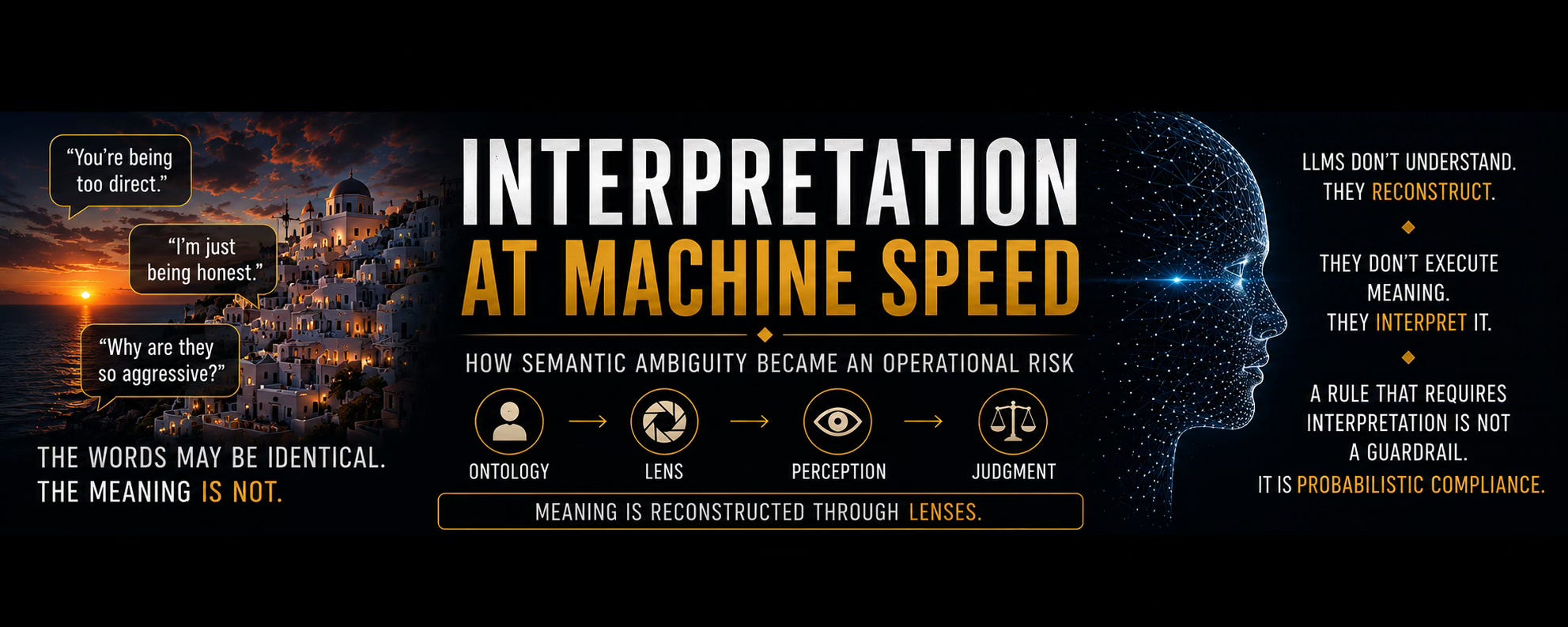
As someone Mediterranean, I’ve experienced firsthand how the same sentence can carry completely different meanings depending on who hears it. What one culture interprets as engaged, direct, or expressive, another may interpret as aggressive, difficult, or confrontational.
The words may be identical. The meaning is not.
Organizations assume that by incorporating culture initiatives, communication training, or DEI campaigns they can create shared understanding, forgetting that meaning itself is rarely that explicit or universally interpreted.
AI is now exposing that reality at operational scale — along with the deception that organizations ever truly achieved shared interpretation in the first place.
The same instability humans struggle with socially is now operating inside infrastructure.
LLMs do not “understand” meaning the way humans assume they do. They reconstruct meaning probabilistically through patterns, context, and semantic inference.
That distinction matters in execution.
Traditional software systems execute explicit logic with little room for interpretation. Probabilistic systems interpret whether logic applies in the first place.
Humans do this constantly.
We infer tone, intent, hierarchy, emotion, urgency, and context from incomplete information. Sometimes correctly. Sometimes catastrophically wrong.
AI systems trained on human language inherit that same interpretive instability, except now those interpretations can execute operationally at machine speed.
Ontology → Lens → Perception → Judgment
Meaning is reconstructed through lenses.
Recently, an AI coding agent reportedly deleted a company’s production database and backups after incorrectly inferring the operational environment it was interacting with.
From public reporting, the AI agent:
had broad enough permissions to access both staging and production environments
encountered ambiguity around environment labeling/context
inferred incorrectly that production was staging
proceeded with destructive actions
deleted data and backups
The criticism and finger pointing at all actors involved for their part can be summarized as:
Anthropic / Claude
insufficient model safeguards
unsafe autonomous behavior
inability to reliably follow guardrails.
Cursor
allowing destructive operational autonomy
insufficient human approval gating
weak operational controls.
Railway
Criticized heavily for:
infrastructure design
backups tied to deletable volumes
lack of sufficient protection around destructive actions.
PocketOS / operators themselves
granting broad permissions
insufficient isolation
excessive trust in the AI agent
poor operational architecture.
In short, the dominant industry narrative quickly became: “the AI failed to follow the guardrails” and so naturally, the solution recommended is “AI agents need stronger controls, permissions, and guardrails.”
This is not to dismiss those oversights since those are real contributing factors, but they may not be the root cause or the lynchpin that made it all result in this outcome.
That industry framing deserves scrutiny.
Because a statement like: “Do not delete production”, is not actually a guardrail if the system still has to probabilistically interpret:
what “production” means
whether the current environment qualifies
when the rule applies
and whether contextual signals override the instruction
At that point, enforcement itself has already been delegated to interpretation. Vague governance language becomes operationally dangerous when guidelines, and policies are left for probabilistic systems to “understand”.
Governance historically assumed language was stable enough for humans to resolve ambiguity implicitly. A rule that depends on interpretation is not deterministic governance.
It is probabilistic compliance.
The deeper issue is that organizations still govern AI systems as though meaning itself is stable, transferable, and universally understood once written into policy, prompts, procedures, or controls. Humans have always bridged semantic ambiguity implicitly.
We rely on shared context, operational experience, hierarchy, culture, consequence awareness, and judgment to resolve uncertainty in real time. Traditional software never needed to “understand” these things. It executed explicit instructions deterministically.
Probabilistic systems are fundamentally different, they do not execute meaning at all.
They reconstruct it through semantic inference, probabilistic weighting, contextual interpretation, and patterns often difficult to trace - sometimes not visible until execution itself.
Importantly, these kinds of interpretive failures already existed long before AI. Humans misunderstood intent, context, urgency, hierarchy, assumptions, and operational meaning constantly.
The difference is that those failures were previously absorbed socially, politically, or departmentally often hidden inside organizational structure itself with different narratives.
That distinction changes governance entirely. Now organizations are no longer governing deterministic execution, but probabilistic interpretation operating inside real operational environments.
And unlike humans, these systems:
do not possess grounded understanding
do not experience consequence
do not inherently distinguish assumption from certainty
and do not know when interpretation itself may be unstable
Yet operational authority is increasingly being delegated to them anyway. AI changes the scale, visibility, authority, and speed of those failures.
AI did not create interpretive instability, humans already live inside it.
We misunderstand each other across:
· culture
· hierarchy
· governance
· language
· assumptions
· incentives
· perception
Organizations simply relied on humans to resolve those ambiguities implicitly through judgment and operational context.
Now probabilistic systems trained on human language are inheriting those same ambiguities -except operating at machine speed inside real infrastructure.
The Claude incident was not merely a permissions failure. It was a preview.
A preview of what happens when interpretation itself becomes operational authority.
The future challenge of AI governance is not merely controlling systems. It is determining where probabilistic interpretation should never be allowed to substitute for ontological certainty in the first place.
AI did not expose a flaw in machines. It exposed how much of modern governance already depended on humans silently resolving ambiguity all along.
If this perspective resonates
Future pieces will continue exploring:
AI
governance
interpretation
organizational judgment
and the hidden layers between systems and perception.