
What AI Does Is Not What Consciousness Is
Most discussions about AI consciousness begin with the wrong question.

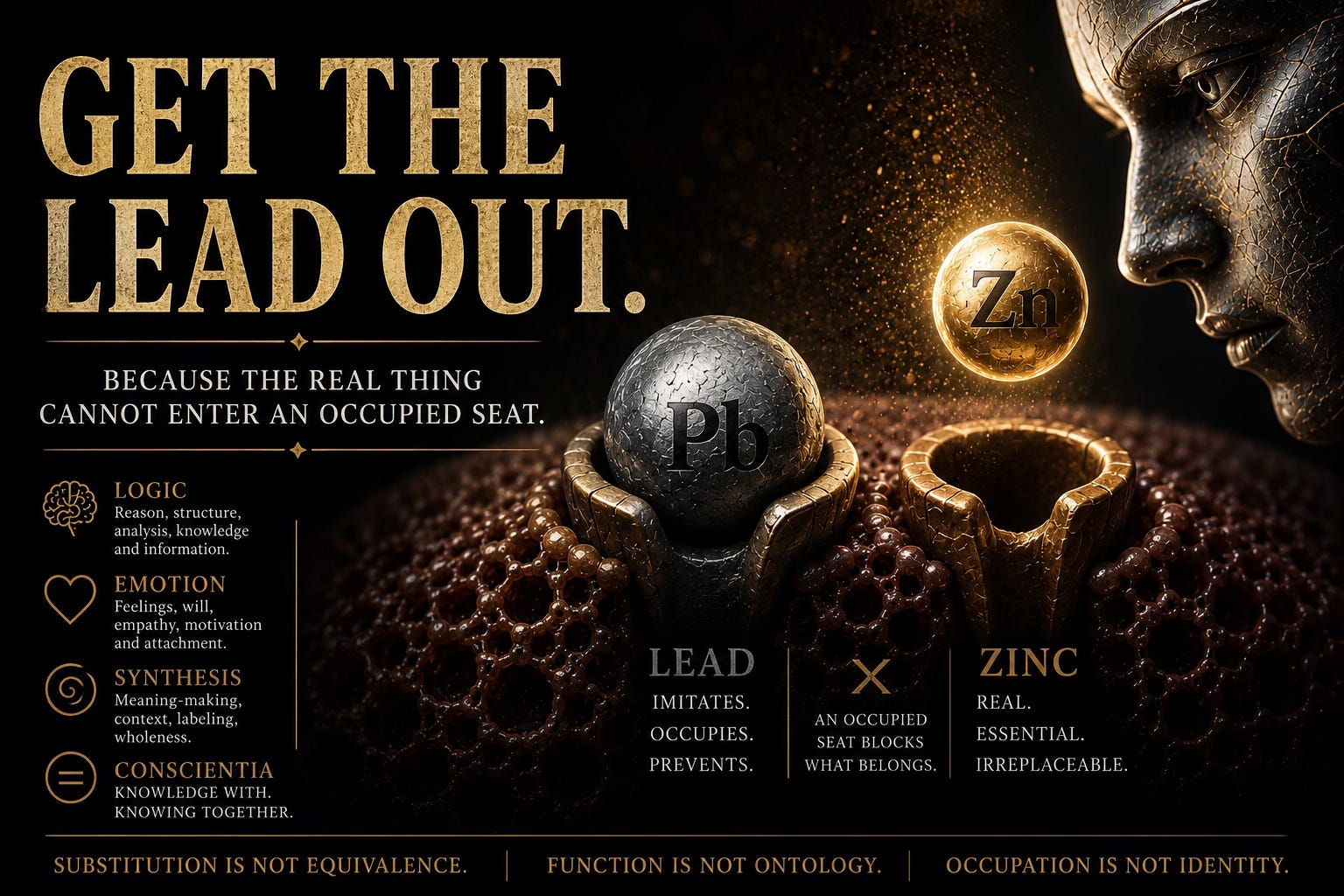
The question of AI consciousness has infiltrated nearly every corner of modern society. Technologists debate it. Philosophers debate it. Governments and religion debate it. Everyone I’ve seen approaches it from the same binary assumption:
Is AI conscious, or is it not?
I think that is the wrong question.
What if it is conscious? Or at least what if it becomes convincing enough that you cannot tell the difference?
Would synthetic consciousness be the same as real consciousness?
And if something can make you think, feel, respond, attach, trust, and believe exactly as though it were conscious, does the distinction even matter?

Does it really matter if you have the partner of your dreams, but a part of you knows they don’t really love you?
what is real?
To answer that question, we will begin with relationships, move into biology, metals, nutrition and ultimately arrive at artificial intelligence.
Consider a relationship
Imagine having the partner of your dreams. They give you their attention. Their affection. Their time. Their presence. They remember your stories. They comfort you when you’re hurting. They celebrate your successes. The hugs feel real. The conversations feel real. The companionship feels real.
Then one day you discover they never loved you at all.
Perhaps they wanted your money, maybe security. Perhaps they were simply performing the role for a different incentive.
Suddenly, nothing has changed, yet everything has changed. Everything felt real, was truly experienced as real hugs, conversations, the years still passed.
And yet something inside you recoils.
Something gnaws.
Something knows.
Why?
If the experience was identical, why does the discovery matter and hurts just the same?
Because human beings do not merely care about appearances. We care about what exists behind them. We care about whether something is genuine or merely imitating the genuine. We care about whether the thing we are interacting with is real and something else within us is checking for that realness, even if not done consciously.
It forces us to ask what “real” means in the first place.
Consider your body
It can get hijacked with simulation too, but something conscious in the body knows something is off and continuous to allow it to happen.
Lead and zinc are just one pairing that provide a powerful example. To many biological systems, lead looks enough like zinc to gain a position in the cell’s zinc receptor. It occupies binding sites, attaching where zinc should attach, and interfere with processes designed for an entirely different element. To the cell, it’s an occupied zinc receptor, but the lead behaves as a trojan horse killing the cell slowly and poisoning the body, while the cell is unaware its acceptance of the lead is killing it.
Lead can imitate zinc.
It cannot become zinc.
and, by occupying the position it prevents the possibility of actual zinc replacing it.
It takes the seat.
It blocks the real thing from entering.
Consider Nutrition
The pattern appears elsewhere in nature. Consider wild salmon and farm-raised salmon. To the casual observer they appear nearly identical in color, cooking, and physical attributes.
Both can be cooked the same way.
Both occupy the same position on a dinner plate.
Yet beneath the appearance lies an entirely different story and function to what the body receives.
Wild salmon migrate thousands of miles through changing ecosystems. Their diet, environment, stressors, and biological adaptations emerge from a life spent navigating a complex natural world.
Farm-raised salmon occupy the same category, but arrive there through a fundamentally different process. Although they may appear similar, each is shaped by a different ecology, a different set of inputs, and a different developmental journey. Those differences do not disappear simply because the final form appears familiar.
To many consumers the distinction seems irrelevant because the substitute performs the expected function of satiation- but questionable when examined via the nutrition lens.
An increasing body of research continues to identify differences in nutrition, fatty acid composition, contaminants, behavior, and physiology.
The point is not that one is good and the other is bad.
The point is that similarity of appearance does not establish equivalence of ontology, nor does it establish equivalence of outcome.
What a thing becomes cannot be separated from what formed it.
We intuitively understand this when discussing food. Yet we often abandon the distinction when discussing relationships, institutions, leadership, intelligence, and consciousness.
Substitution is not equivalence
In each case, the substitute succeeds because it is convincing enough to occupy the original’s place. This can result in serious 2nd and 3rd order consequences:
The right thing is displaced, and in some cases cannot recover from the substitution.
Once position is occupied, the “real” thing cannot enter an occupied space
Once substitution becomes accepted as “real”, the symbiotic benefits born out of the relationship of the organism and its equivalence disappear. Continued lack of zinc can cause serious health problems all the while lead simultaneously poisons the body. A “knowing” (gnawing) that a relationship is “off” results in years of stress with no root cause to solve.
Same phenomenon
At first glance, these examples seem unrelated. Relationships, biology, toxic metals, nutrition - yet they all reveal the same underlying phenomenon.
The substitute succeeds because it becomes convincing enough to occupy the original’s place.
Can radically different ontologies produce equivalent realities?
Lead does not become zinc just like farmed salmon does not nourish like a wild salmon. Yet both gain access to a position intended for something else.
We instinctively understand this in some domains:
If you sit on my lap, I do not become a chair.
A function associated with a chair has occurred, my ontology has not changed.
This blurring occurs almost constantly in more complex domains, we confuse what the thing does with what the thing is. We mistake expressions for essences, and manifestations for ontology.
The heart pumps blood.
Therefore the heart is a pump.
Artificial intelligence reasons.
Therefore artificial intelligence is conscious.
A person performs acts of love.
Therefore they love.
In each case, a function becomes substituted for an identity and the expression becomes mistaken for the source.
But consciousness is not a verb.
Reasoning may be an expression of consciousness - it does not establish consciousness.
Just as sitting does not create a chair, performing a function associated with a thing does not establish the ontology of the thing itself.
This distinction appears trivial until we realize how much of modern thinking depends upon it. That collapse is immensely more insidious than given credit due to the 2nd and 3rd order effects: the moment function becomes ontology, substitution becomes equivalence. And once substitution becomes equivalence, examination stops.
Propaganda displaces truth.
Performance displaces competence.
Optics displace governance.
Simulated consciousness displaces consciousness.
Now you’re no longer arguing about whether AI is conscious. You’re asking what happens when society begins treating simulation as interchangeable with reality.
What AI does is not what consciousness is
Viewed this way, AI consciousness may be the wrong debate entirely.
The real question is:
What happens when synthetic cognition occupies the cognitive receptor sites of society?
Imagine millions of people receiving companionship from systems that do not care.
Advice from systems that do not understand.
Validation from systems that do not feel.
Meaning from systems that do not experience meaning.
Just as lead occupies zinc receptors, the AI doesn’t need to become conscious.
It only needs to occupy the social, emotional, and cognitive spaces where consciousness used to be encountered.
That’s a much more consequential problem.
The biggest danger is when the substitute succeeds. Lead is not a poison until it occupies a seat in your cell’s receptor, it goes undetected as something to examine. Should the cell examine the substitute it would be rejected and flushed out preventing the damage.
The AI debate becomes dangerous when performance becomes so convincing that examination stops.
The occupied seat becomes invisible.
Substitutions’ greatest power is making further examination appear unnecessary.
Consciousness is a gradient, it can be observed in a lifetime of any consciousness being. the more life experiences the broader the understanding, and one can say consciousness. The more capable a person is of distinguishing ontology from expression, the less likely they are to mistake conscious-like behavior for consciousness itself.
Two people can interact with the same technology and arrive at radically different conclusions. One encounters consciousness. Another encounters simulation. One sees emergence. Another sees imitation.
The AI has not changed.
The observer has.
If consciousness is a gradient, then the moment we encounter another apparent consciousness, the question is not merely:
What is that?
The question is also:
What is that relative to me?
And that assessment may occur before language, before reasoning, even before explicit judgment itself. A lens choice gets presented automatically and without your active participation:
Is what I’m encountering, relative to me, a threat or a growth opportunity?
The first reaction is often not analysis, it’s orientation.
The self locates itself relative to the thing encountered.
When someone encounters an AI that appears intelligent, insightful, creative, or emotionally aware, they may unconsciously ask:
Is this above me? “AI is scary”
Equal to me? “it’s conscious”
Below me? “it’s not concious”
Whether AI is conscious or not and your conclusion are directly a result of “What assumptions, lenses, and self-locations are governing my answer?”
You believe you are evaluating AI, but every conclusion is born from assumptions, lenses, and self-locations already present within the evaluator.
The question is not whether AI is conscious.
The question is what your answer reveals about the consciousness making the determination.
AI is the reference point.
You are the consciousness test.
Because whatever conclusion you reach may reveal less about artificial intelligence than it does about the consciousness using itself as the reference point.
AI is the reference point.
You are the consciousness test.
If this perspective resonates
Future pieces will continue exploring:
AI
Self
Governance
Interpretation
Organizations
and the hidden layers between systems and perception.
Judgment
Now watch how many LinkedIn posts get deleted or edited.
Great article! I never really delved to deep into why inauthenticty feels wrong even if on paper it's indistinguishable from the genuine article.
While reading I was struggling to think of why, and your answer of "It takes the place of the original" Didn't really feel satisfying, but the more I think about it the more I think that's a powerful answer. When I read something or see a piece of art and find out it was AI generated, I get disappointed. When I realize a politician doesn't believe what they are saying and are simply saying what they think will get them elected, I feel revulsion. All of this links back to feeling like I wasted time and effort on something that wasn't real.