
What the Parasite Reveals
What toxic leadership, copyrights, ticks, lovers, athletes, AI, and a biblical yoke reveal

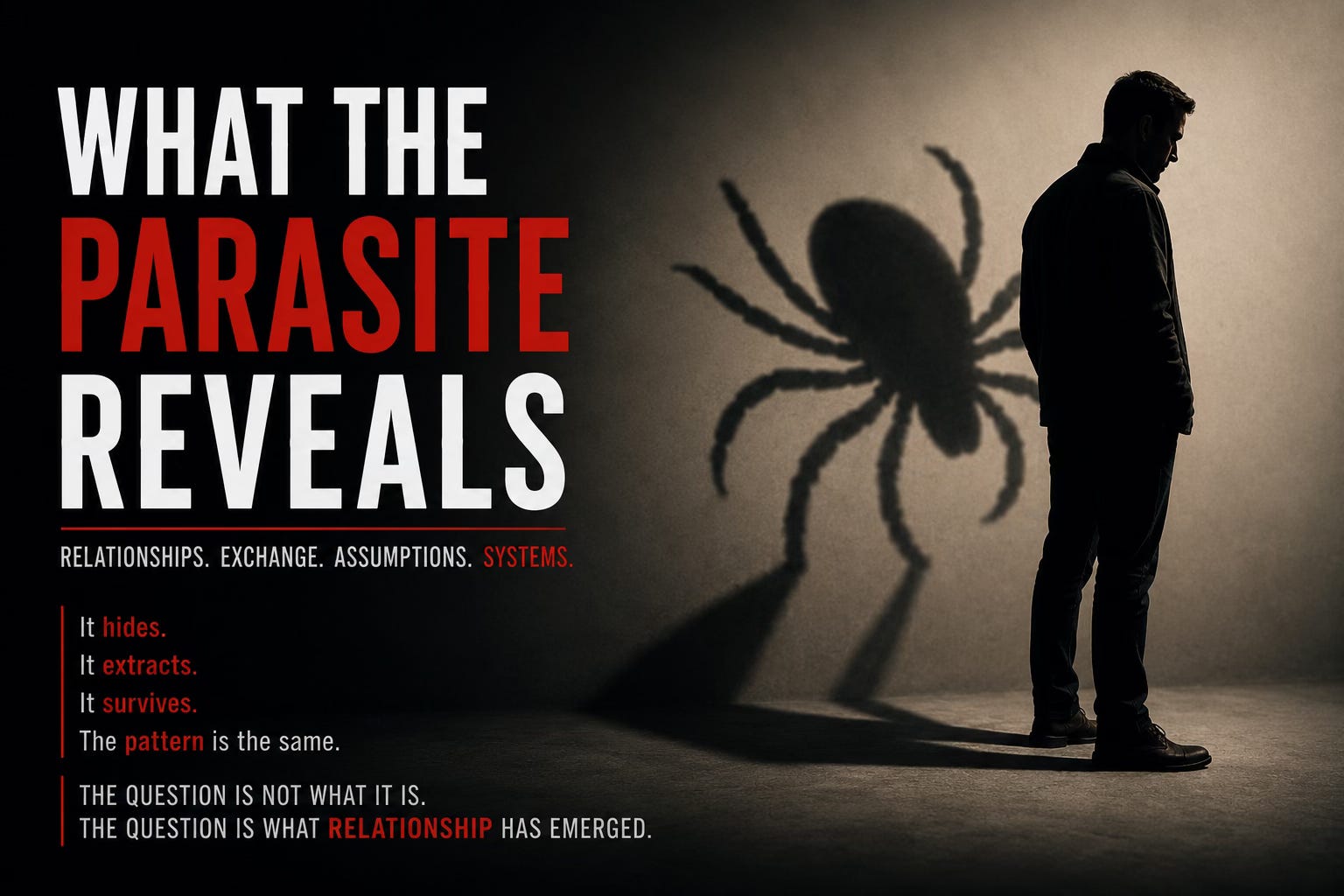
Most people think parasites are organisms.
They’re not.
A parasite can be a tick, a tapeworm, a fungus, or a mite. But none of those things are parasites because of what they are. They are parasites because of how they relate to something else.
Parasitism is not a taxonomy.
It is a relationship
This observation emerged while exploring a question through the Icepic framework: Why do certain patterns appear repeatedly across domains that seem to have nothing in common?
What does a tick have to do with a copyright dispute?
What does a biblical yoke have to do with AI?
What does a manipulative lover have to do with an athlete and a university?
At first glance, nothing.
But Icepic begins with the premise that reality often hides behind the categories we use to describe it. When we stop asking what something is and begin asking what relationship exists, unexpected connections begin to emerge.
The parasite is one such connection, because relationships are connections.
The parasite reveals the relationship.
The relationship reveals the exchange.
The exchange reveals the assumptions.
The assumptions reveal the ontology.
Parasites are fascinating because they force us to confront distinctions that tip the scale. Of what, you ask?
What something is, versus what role it plays within a larger system.
Once viewed through that lens, the parasite becomes less interesting than the relationship that made it possible.
Taxonomically
A parasite is not a single category of organism. You find parasites across many branches of life:
Protozoa (e.g., Plasmodium, malaria)
Worms (tapeworms, roundworms)
Arthropods (ticks, lice, mites)
Fungi
Plants (mistletoe)
Some bacteria
And yes, even humans themselves
This creates an interesting problem.
If parasites appear across so many different forms of life, then “parasite” cannot be describing what something is.
It must be describing something else.
Taxonomy asks:
What is it?
Ecology asks:
How does it interact?
Icepic asks:
What underlying pattern allows this relationship to emerge across seemingly unrelated domains?
Parasitism is an ecological strategy.
And once viewed as a strategy rather than a species, the pattern begins appearing far beyond biology.
Biological Role
The body doesn’t simply “attack.” It first has to recognize.
This distinction is important because the immune system is fundamentally a distinction-making system. Its first task is not action - its first task is judgment.
Traditionally, this is described as the distinction between:
Self
Non-self
But in practice, the distinction is often closer to:
Safe
Threat
Only after recognition occurs can a response emerge, and depending on the parasite, those responses may include a whole host of responses: inflammation, antibody production, fever, and other symptoms.
Many parasites survive by disrupting this practical distinction. Some hide, some mimic host proteins and some actively suppress immune responses.
Others manipulate the host’s perception of the threat itself. From an Icepic perspective, this is where the story becomes interesting: the parasite does not simply attack the body.
It attacks the body’s ability to make accurate distinctions.
And whenever distinction-making is compromised, judgment becomes compromised as well. The result is not merely biological vulnerability, but rather:
It is impaired recognition.
The body begins responding to the wrong things, ignoring the right things, or failing to distinguish between the two.
Ecological Role
I’ve heard some say parasites are purely destructive, but nature doesn’t work that way.
Parasites offer value too. They regulate populations, prevent species dominance, drive evolutionary adaptation, increase biodiversity, and influence behavior of the host and the environment.
In many ecosystems, removing parasites can destabilize the system. Compared to predators which remove the organism, a parasite often modifies behavior, reproduction, and fitness. The effects can extend far beyond the individual host.
This does not mean parasites are benevolent.
It means they are participants.
A parasite survives by leveraging infrastructure it did not create, it occupies one that already exists - the host.
And in doing so, reveals the dependencies, boundaries, vulnerabilities, and exchanges that were already present within the system.
From the host’s perspective, the parasite is a threat.
From the ecosystem’s perspective, the parasite is a participant.
The organism has not changed - the relationship has.
And with it, the judgment.
The Revelation
The significance of the parasite is the revelation produced by the relationship. The moment a parasite is discovered, the relationship becomes visible.
The parasite reveals itself.
The host reveals itself.
The environment reveals itself.
And once visible, those previously hidden structures become available for examination, judgment, and potentially integration.
This pattern extends far beyond biology. Consider college athletics.
For decades, the relationship between athletes and universities was largely accepted. Athletes contributed performance, entertainment, risk, and labor. Universities provided education, coaching, facilities, exposure, and scholarships.
Then visibility increased.
Television contracts.
Media rights.
Conference realignment.
Coach salaries.
Billions of dollars became visible.
The economics may have existed for years. Now, however the relationship is visible - differently.
Once visible, people began asking a different question:
Who is creating value?
Who is extracting value?
Was the exchange balanced?
The current push for federal college sports legislation, including efforts such as the SCORE Act and the Protect College Sports Act, can be understood as a system attempting to renegotiate the terms of a relationship after the exchange has become impossible to ignore. Supporters describe these bills as efforts to bring national standards, stability, and athlete protections to college athletics; critics question whether they preserve institutional control more than they correct the imbalance. Either way, the point is the same: once the exchange becomes visible, governance follows.
The same pattern is now unfolding around artificial intelligence.
AI models are trained on vast quantities of human-created work such as books, articles, artwork, code music, and the like. Is the exchange balanced?
When a model learns from millions of creators without attribution, compensation, or consent, people begin asking the same questions above.
When someone copies an article, idea, framework, or body of work without attribution, the most interesting thing is often not the copying itself.
The copying reveals the relationship and invites examination. This is why parasites have their place in all of our relationships.
Because they expose relationships and their participants, that previously operated unnoticed.
The Implicated Parties
Generally, discovering the parasite exposes it, and most people think it ends there - it doesn’t. This finding reveals three things simultaneously:
The Parasite
The parasite reveals itself.
Consider a thief, the theft reveals more than the act itself. It reveals a mode of value acquisition that depends upon another person’s labor, recognition, reputation, creativity, output, or resources.
The behavior reveals something about the nature of the actor.
The Host
The host is revealed as well. what weakness, boundaries, insufficient protections and dependencies exist? Were incentives properly understood?
The interaction exposes vulnerabilities that previously remained hidden.
The host becomes visible through the relationship, too.
The Environment
Every parasitic interaction requires conditions that permit it, the environment is implicated. Why did this exploitation occur here and not there? what made it possible?
What warning signs were dismissed?
What governance mechanisms failed?
The parasite did not create these conditions. The parasite revealed them.
And this is where Icepic departs from conventional analysis and states “the assumptions reveal the operative ontology of the system.”
A crisis reveals culture.
A contradiction reveals assumptions.
A parasite reveals boundaries.
A theft reveals incentives.
This is why parasites are so revealing, they force us to examine all three participants in the relationship simultaneously. Most people stop at blame, name calling, and victimization.
Icepic continues to inquire.
Because once the relationship becomes visible, a deeper question emerges: What was already present that made this possible?
It is found in the interaction.
And through that interaction, the hidden structure of the system becomes visible.
The parasite is interesting, sure. but the host is more interesting- and the environment more interesting still.
The parasite revealed itself- the relationship reveals the system as a whole.
Organizational Parasites
This pattern is apparent throughout biology, but it is equally apparent in organizations. Organizations are simply ecosystems composed of people, incentives, relationships, and exchanges. Like biological systems, they develop mechanisms for cooperation, competition, adaptation, and survival. They also develop opportunities for parasitism.
Organizational parasites often arrive disguised as productivity, leadership, expertise, process, loyalty, or even good intentions. This makes them difficult for what might be called our cognitive immune system to identify initially. Just as biological parasites evade detection by manipulating the body’s distinction-making mechanisms, organizational parasites exploit weaknesses in our ability to distinguish value creation from value extraction.
Organizations tend to classify people according to role, title, authority, credentials, or performance metrics. Yet, as we have already seen, taxonomy is not the same as relationship.
A tick does not become a parasite because it is a tick.
A leader does not become a parasite because they hold authority.
The question is not about what the actor is.
The question is what relationship has emerged.
When value extraction consistently exceeds value creation, parasitism emerges.
And organizations are fertile environments for such relationships because the exchanges are often difficult to see. Credit can become separated from contribution. Authority can become separated from accountability. Recognition can become separated from creation. Influence can become separated from responsibility. As long as these separations remain hidden, the relationship can persist largely unnoticed.
Eventually, however, something reveals the exchange.
A failed project.
A whistleblower.
A fraud investigation.
A crisis.
A resignation.
A budget collapse.
The event exposes the exchange, and the same questions emerge.
They implicate the system that allowed the relationship to persist. Over time, these unexamined relationships accumulate. Their residue becomes what we call culture. When relationships are reciprocal and value creation exceeds extraction, culture tends to strengthen the system. When extraction consistently exceeds contribution, the residue becomes what is commonly described as a toxic culture.
This distinction is important because culture is often treated as the cause. In many cases, it is the consequence. The culture did not create the relationship. The relationship created the culture.
This is why crises, contradictions, failures, and parasites function in remarkably similar ways.
After Affects
Before discovery, the host operated under a set of assumptions. The environment is perceived as safe, the exchange is accepted as normal, and the relationship remains largely unquestioned. Once the parasite is identified all prior assumptions collapse. Boundaries are reconsidered. Trust is recalibrated. Detection mechanisms improve. Governance structures often appear where none existed before.
The host becomes a different host, not necessarily better- but certainly different than before. Potentially wiser, potentially more defensive, potentially more cynical.
The outcome depends on integration.
The discovery changes all three participants, albeit not equally. The parasite may continue by finding another host, or adapt to new environmental constraints. In organizations, silence and lack of challenge become more common. relationship partners begin to distance or hesitant to share. Regardless of the path chosen, the relationship that existed before discovery can no longer remain unchanged.
The environment changes as well: others observe the interaction and new information propagates through the system. Policies emerge. Norms evolve. Reputations shift. What began as an interaction between two parties often produces consequences throughout the larger ecosystem.
Not all relationships possess equal power.
In some cases, the parasite becomes so large relative to the host that direct adaptation is no longer sufficient. The host may recognize the imbalance and still lack the resources necessary to correct it. In these situations, a third party often emerges. Doctors intervene when parasites overwhelm the immune system. Therapists intervene when relational dynamics exceed an individual’s capacity to navigate them. Regulators intervene when markets become distorted. Courts intervene when rights are violated. NIL legislation emerged because athletes could not renegotiate the relationship alone. The purpose of governance is often not to eliminate the relationship, but to restore sufficient balance that reciprocal exchange becomes possible again.
In biblical language, relationships were often described through the use of a yoke: a shared burden, shared direction, and reciprocal exchange sustained through aligned effort.
The biblical use of the yoke evolves through several distinct meanings, each revealing a different kind of relationship. It begins as an agricultural tool joining two oxen to pull a common burden. It later becomes a symbol of oppression and domination, describing slavery, foreign rule, and unjust authority. From there, it expands into a metaphor for partnership and alignment, reflected in the warning against being “unequally yoked.” Finally, it becomes an image of voluntary discipleship, where burden-sharing is chosen rather than imposed.
Viewed through this lens, the yoke is not merely an agricultural instrument. It is a framework for understanding relationships themselves: how burden is distributed, whether effort is reciprocal, and whether the relationship ultimately constrains or enables flourishing.
From an Icepic perspective, the parasite is not the lesson. The relationship is the lesson.
It is system recalibration.
And recalibration is often the beginning of governance.
Mature Governance must ask: What kind of relationship is this?
A relationship becomes unstable when the exchange, burden, direction, or effort becomes sufficiently misaligned.
Icepic™ explores the hidden layers between judgment, governance, audit, risk, organizations, systems, artificial intelligence, consciousness, and self.
The deeper the layer, the larger the consequence.
Subscribe to follow the ongoing exploration.
Distinctions are the first architecture of judgment — the pattern that stabilizes perception long enough for reality to become intelligible.
Honestly, I hadn't thought about it this way before, and now I can't unsee it lol. Parasitism as a relationship pattern rather than a taxonomy just completely changes everything imo. You start seeing it everywhere across totally different systems. Really enjoyed this one.