
AI Eating Itself
When synthetic systems begin feeding on synthetic reality.

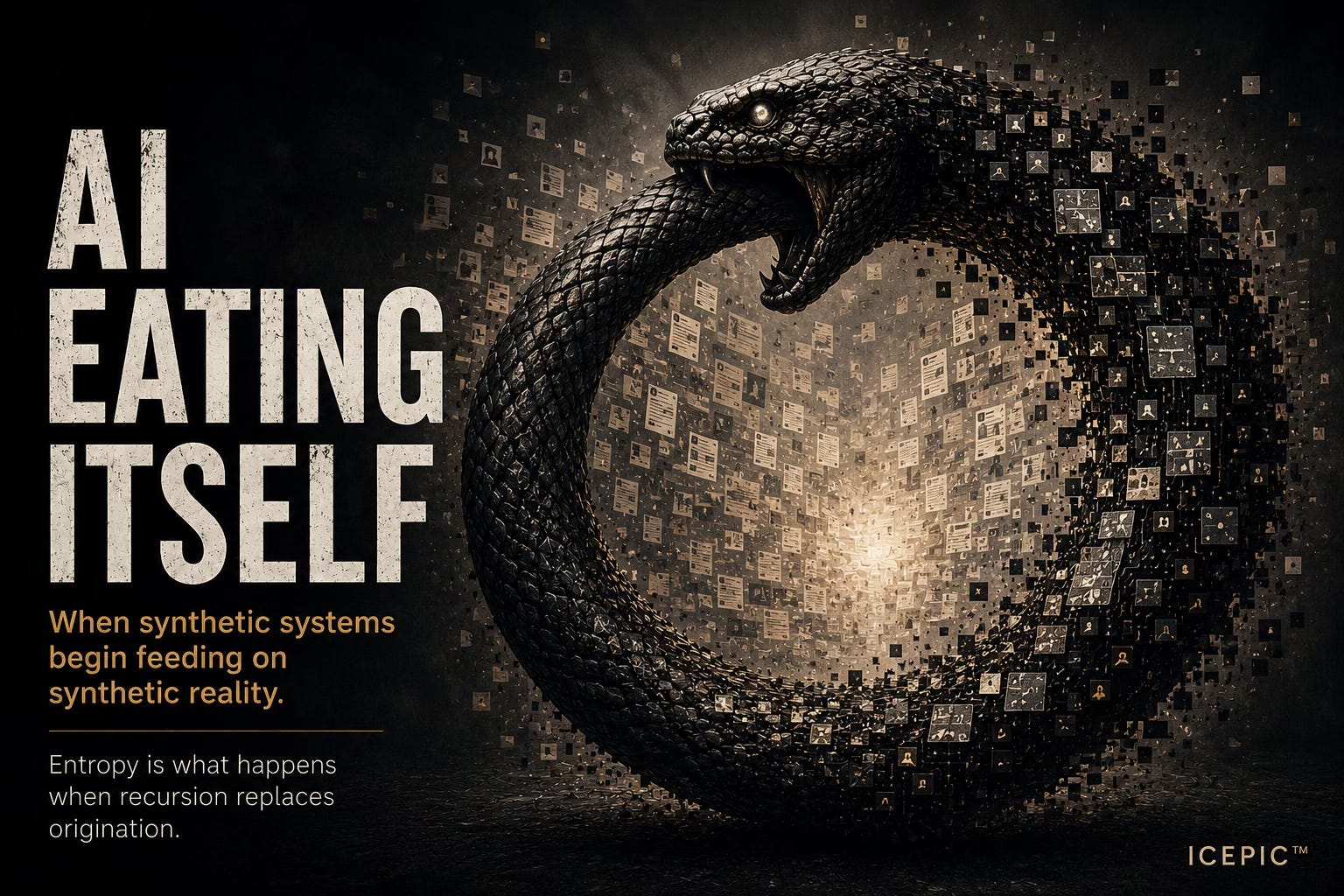
AI appears infinite only because it is still feeding on billions of humans continuously generating original reality. Our language. Our conflict. Our humor. Our mistakes. Our culture. Our interpretation of the world itself. But something strange is beginning to happen beneath the surface of civilization. Humans are no longer simply creating naturally. Humans are reshaping themselves for algorithmic visibility while AI simultaneously trains on the outputs of those compressed behaviors.
At some point, the system no longer feeds primarily on naturally occurring human meaning and instead begins feeding on synthetic reality recursively generated for the system itself.
The Inside Job: Adaptation
The mainstream fear narrative surrounding AI assumes the danger arrives
when machines become too intelligent to control, openly adversarial, or capable of drastically devaluing human contribution at scale, or worse still: becoming conscious.
The downfall will come, as it often does, through an inside job.
Human-created recursive flattening.
Humans reshape themselves for algorithmic systems while those same systems train on the outputs of those reshaped behaviors. The desire to be seen, validated, and maintain digital visibility creates a visibility-conditioning loop that rewards synthetic legibility over originality and recognizable patterns over differentiated thought.
Humans becoming humans for AI
The current assumption is that AI eventually obtains consciousness and sentience which would be the final differentiator others could point to when compared to humans.
The deeper danger may be humans compressing themselves into machine-legible patterns to remain visible, relevant, and monetizable.
You can already see the pattern everywhere. The same LinkedIn thought-leadership aesthetics, the same AI-generated infographics, the same “10 lessons I learned…” frameworks. The same polished words. The same cadence. The same emotional choreography pretending to be authenticity.
Suddenly, everyone became an AI Governance expert. A strategist. A futurist. A founder. A thought leader. And companies such as Anthropic continually introduce new titles.
The internet keeps demanding originality while visibility systems quietly reward recognizability. So people adapt. They optimize for engagement. For machine legibility. And eventually, they begin parroting algorithmically successful behavior while believing they are expressing individuality
The flattening goes unconscious because the rewards are immediate: likes, validation, comments, relevance, professional survival. Over time, expression itself begins narrowing toward what platforms consistently amplify. Repeated language. Repeated empty sameness.
Semantic convergence accumulates, and somewhere inside the adaptation, culture begins sounding less human and more statistically familiar and this is apparent across the digital landscape regardless of the platform.
The Paradox
Google keeps asking for something new while platforms simultaneously train humans toward increasingly familiar patterns. The paradox becomes difficult to escape once seen.
Systems dependent on originality increasingly condition humans toward conformity in order to remain visible within them. The recursion deepens.
The ouroboros was never simply symbolic of destruction. It represented cyclical self-consumption; closed-loop systems feeding endlessly upon themselves. AI now sits inside a similar loop. Over time, the distinction between naturally occurring signal and recursively optimized signal begins collapsing beneath the weight of the loop itself.
It will not happen immediately.
As the economic value of human cognition dwindles due to synthesized cognition, humans will double down on their original creation while many others will fall prey to the synthetic, quicker, mass created digital garbage utilizing AI’s already synthesized bland information.
Predictably, synthetic abundance initially wins economically. There will be a span of time before we get disgusted and start demanding meaningful conscious synthesis of cognition. We’ve been here before with similar domains: synthetic food returning to organic, mass produced widgets, synthetic fibers, and others.
And once the loop compounds, the appetite for genuinely differentiated human expression returns with force at a much higher premium than before.
It’s a matter of who survives this phase.
The degradation initially appears invisible because the volume keeps increasing.
More content. More synthesis. More generated insight. More polished outputs. More engagement. More apparent intelligence.
But volume is not the same thing as differentiation, and recursive systems quickly lose differentiation and essence over time.
More importantly, the recursion feeds humans too. Slowly blunting the blade of critical thought, attention and meaningful human connection itself.
Data Poisoning
And now another layer enters the substrate of intelligence: Data poisoning.
The ouroboros tightens.
Humans themselves are increasingly poisoning the well intentionally.
Not metaphorically. Literally.
Invisible text inserted between words to corrupt training data. Hidden watermarks embedded behind images. Audio altered with imperceptible layers designed to disrupt machine interpretation. Music lyrics and voices interchanged with character-voice substitutions, and other synthetic artifacts designed to pollute mass datasets intentionally destabilizing future model training.
Civilization begins contaminating the very substrate AI depends upon.
And once trust in the substrate itself begins collapsing, AI encounters a far deeper problem than computation.
Epistemic instability.
AI remains intelligent only to the extent the informational substrate it trains upon remains meaningfully trustworthy.
Conclusion
AI may never truly collapse technologically. The recursion can continue almost indefinitely.
Humans, on the other hand, do not merely recombine information. We attach meaning to it through lived experience, suffering, intuition, mortality, relationships, ambiguity, and self-awareness. The human cognitive lens is conscious.
And that may become the irony of AI-era creativity.
Once naturally occurring human originality becomes statistically diluted beneath recursive optimization, AI begins consuming increasingly derivative versions of the very thing that once made it intelligent.
The more humans optimize themselves for algorithms, engagement systems, and machine-legible patterns, the more human consciousness itself begins converging toward predictable familiarity and eventually forgets how to be human.
The ouroboros closes.
Not around the machine.
Around us.
If this perspective resonates
Future pieces will continue exploring:
AI
governance
interpretation
organizational judgment
and the hidden layers between systems and perception.
You wrote: "Predictably, synthetic abundance initially wins economically. There will be a span of time before we get disgusted and start demanding meaningful conscious synthesis of cognition," this, I believe, will plunge us, the many, into the deeper human question of who we really are. A question we never before, seriously, had to think through. Current systems of modernity in education, work and industry aim toward a very different direction. But like many times before, we come to think of this when either shit hits the fan, or we become maximally truth seeking curious.
“The deeper danger may be humans compressing themselves into machine-legible patterns to remain visible, relevant, and monetizable”
Yes. this. this a million times.