
The New Economy Doesn't Need Whole Humans
The oncoming largest identity shocks in human history.

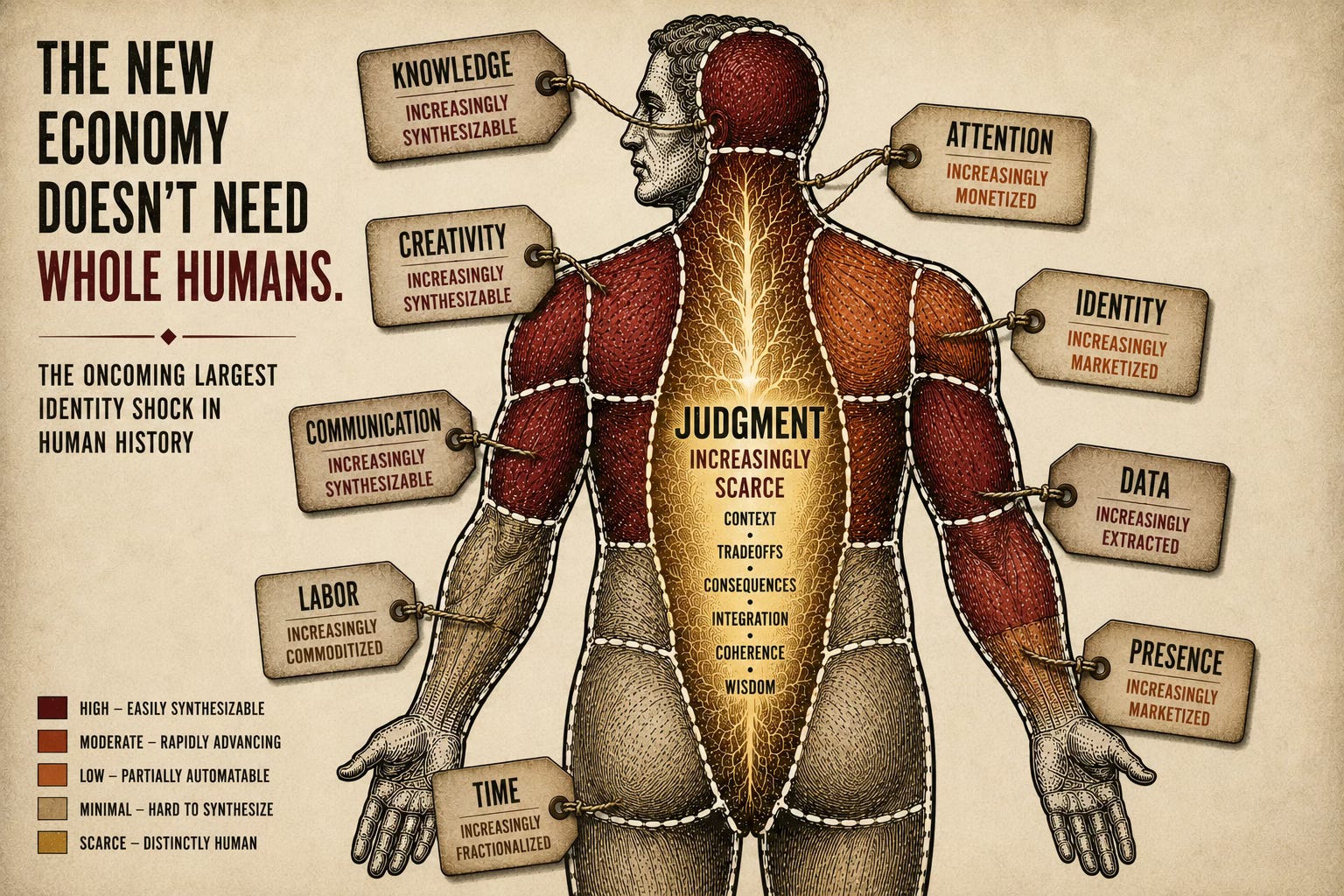
For centuries, humans validated their existence and economic value as a whole identity. A farmer was not merely hands, nor a craftsman not merely skill, likewise, a professor was not merely knowledge, nor a leader not merely communication.
The market purchased the integrated human. The individual arrived as a complete package of strengths, weaknesses, experience, relationships, reputation, labor, intuition, memory, and identity- and it was priced according to the environment.
How Human Value Was Priced
The Industrial Age rewarded physical labor. Physical labor tied value to presence, locality, and embodied ability. It could not be replicated easily, so it remained scarce. The Information Age rewarded knowledge, and humans supported massive economical comforts based on their value in different categories. With globalization, in the beginning of the 20th century, the digital era dissolved physical presence. The environment expanded around humans - digitally - now offering more valuable whole humans to environments that didn’t have access to that level of human before.
As labor became automated, knowledge became valuable.
As knowledge became abundant, humans sought new forms of differentiation: intelligence, emotional intelligence, credentials, proximity, language, culture, and identity itself.
Each represented an attempt to reclaim scarcity.
In the 21st century, AI introduced abundant knowledge, synthesis at scale, and automation explosion. For the first time, cognition can be separated from the individual and synthesized.
Snowflake Decomposition
(You’re Not That Special-Economically)
Something fundamental is changing. Even the pope himself echoed the fear of all humans: what about jobs? what about purpose? AI is dissolving the relationship between physical presence, cognition, and economic worth of each human in the modern economy. “Human in the loop” increasingly sounds less like a design principle and more like a psychological reassurance that humans still matter.
This is not merely a technological shift.
It is an ontological shift in how human value is perceived, extracted, and compensated.
The emerging economy is no longer purchasing whole humans, it is purchasing capability components. The economic unit is no longer the person as a whole, the unit is becoming the capability.
For generations, people built identity around their economic function.
“I am a lawyer.”
“I am a writer.”
“I am a designer.”
“I am a teacher.”
“I am a manager.”
The title is not simply employment - it is identity.
When an employer hired a person, they got:
knowledge
communication
relationships
culture
presence
availability
loyalty
institutional memory
future potential
all bundled together. The salary purchased the bundle.
The emerging model increasingly asks:
Why buy the entire bundle if I only need 7 minutes of analysis?
Why hire the writer if I only need the writing capability?
Why employ the designer if I only need three design outputs this month?
This is where the coming identity shock begins.
Historically, what humans produced was targeted and annihilated with machinery and mass production, better, faster and cheaper- and we’re in on it, we liked the economic savings.
Today, automation increasingly targets cognition: what we know, how we create, communicate and connect with other humans. It uses our senses and reality contact to extract meaning we pour into every one of those actions.
The result is a form of human decomposition.
The economy begins separating human value into individual components and purchasing only the portions it requires. Each component becomes independently measurable, independently purchasable, and increasingly independent from the human who originally embodied it.
This is why the coming disruption feels different. The implications extend far beyond employment, people do not simply lose income when economic value shifts. They lose everything born out of that: security, status, narrative and personal worth. They lose the structures through which they understand themselves.
The old economy paid humans and received capabilities.
The new economy pays for capabilities and discards the rest.
Humans Do It Too
Humans have always valued each other fractionally, too. We rarely evaluate people as whole beings, we evaluate fragments.
One person is valued for beauty.
Another for intelligence.
Another for status.
Another for wealth.
Another for humor.
The same individual can be highly valuable in one environment and nearly invisible in another. Value has never existed inside the person alone, but rather emerges from the relationship between the person and the environment evaluating them. A brilliant physicist may possess enormous value inside a research laboratory and almost none at a dinner party. A comedian may dominate a social gathering and contribute little inside a nuclear engineering meeting.
AI simply accelerates and industrializes the process, what once occurred informally through human judgment increasingly occurs through markets, platforms, algorithms, and automated systems.
The decomposition was already happening, we unconsciously value only the dimension that benefits us.
Technology merely made it visible.
That’s why the emotional intensity around AI feels disproportionate to the technical arguments.
People think they are arguing about copyright, jobs, artists, or automation, but underneath, many are actually confronting:
ontological insecurity
economic invisibility
loss of embodied identity
collapse of scarcity-based self-worth
What Remains
If my value is no longer physically embodied, geographically anchored, or visibly tied to labor… how do I prove I exist economically at all?
The answer may reside in something much harder to separate from the whole human.
Judgment.
The ability to integrate context, understand consequence, and navigate tradeoffs. The ability to maintain coherence across competing realities and pull from both intellectual and intuitive abilities.
Judgment is not merely another capability. True sound judgment is the connective tissue that integrates all other capabilities into something functionally sound. It is known many of today’s roles sell judgment: consultants, lawyers, executives, etc. The market has always purchased judgment evaluated through proxies that sometimes were correct and other times proved incorrect. Qualifying judgment itself and providing it will prove valuable.
The last 50 years may have trained people to include judgment cheaply.
The next 20 years may make judgment the most valuable thing they own.
And ironically, this may push humanity toward rediscovering something important:
Consciousness, meaning, relationality, presence, intuition, lived experience, and existential interpretation are not judgment itself.
They are the raw materials from which judgment emerges.
Value always migrates to what cannot be cleanly decomposed.
A precursor to this is AI Eating Itself you may find interesting.
If this perspective resonates
Future pieces will continue exploring:
AI
governance
interpretation
organizational judgment
and the hidden layers between systems and perception.
Snowflake Decomposition
The realization that being unique and being economically scarce are not the same thing.
The economy once purchased integrated humans.
Increasingly, it purchases capabilities.
The identity shock occurs when people discover the market values only a fraction of what they believe themselves to be.
Well according to that image, at least ChatGPT can't emulate my spinal column yet :v